YUNYAO Get in touch

Exploring Autonomous Driving Through Mixed Reality

A research demonstrator for the BeIntelli autonomous driving initiative at DAI-Labor / TU Berlin.

Industry
Mixed Reality, Autonomous Driving
Responsibilities
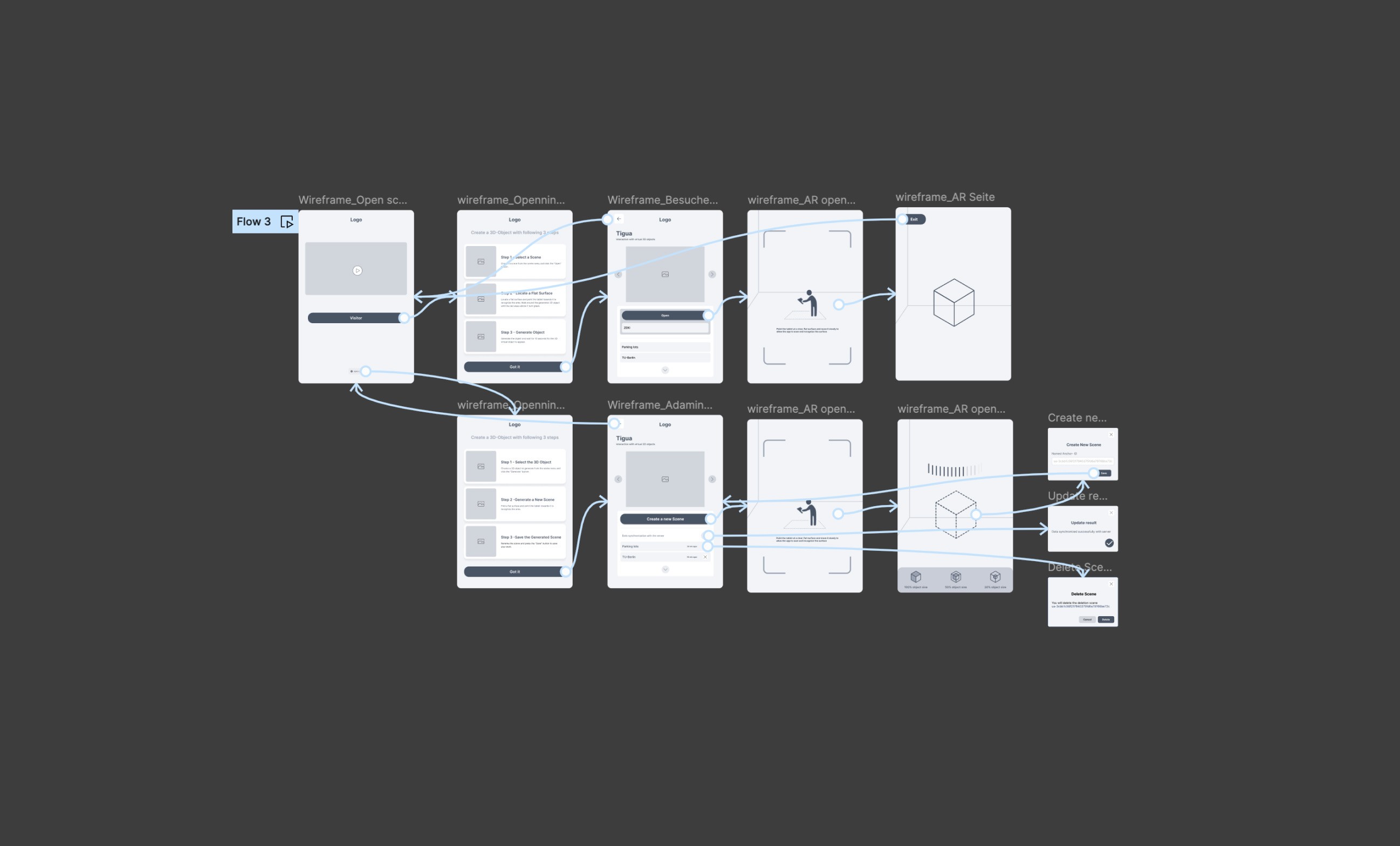
I led BeIntelli AR end-to-end as Product Owner and sole UX/UI designer. I owned the native app interface, the spatial overlay design, the information-layer logic, the interaction model, and the user flow through the application. I also conducted the internal user testing that fed back into the design iterations. The technical implementation was carried out by the mixed-reality engineer in our team; my role was to define what the experience should be and to coordinate with the BeIntelli autonomous-driving team for data, requirements, and live integration.

Beintelli AR is a mixed-reality tool developed to support the BeIntelli autonomous driving project. It enables visitors to interact with and gain a deeper understanding of the technology and sensors used by the BeIntelli team in the development of autonomous driving systems.

01 · Process

Designing for two demo contexts

Within the BeIntelli project I held a dual role as Product Owner and sole UX/UI designer. Product ownership meant negotiating requirements with the BeIntelli autonomous-driving team, prioritising scope, and briefing the mixed-reality engineer who carried out the technical implementation. Design ownership covered the native app, the spatial overlays, the information layer, the interaction model, and the user flow end-to-end.

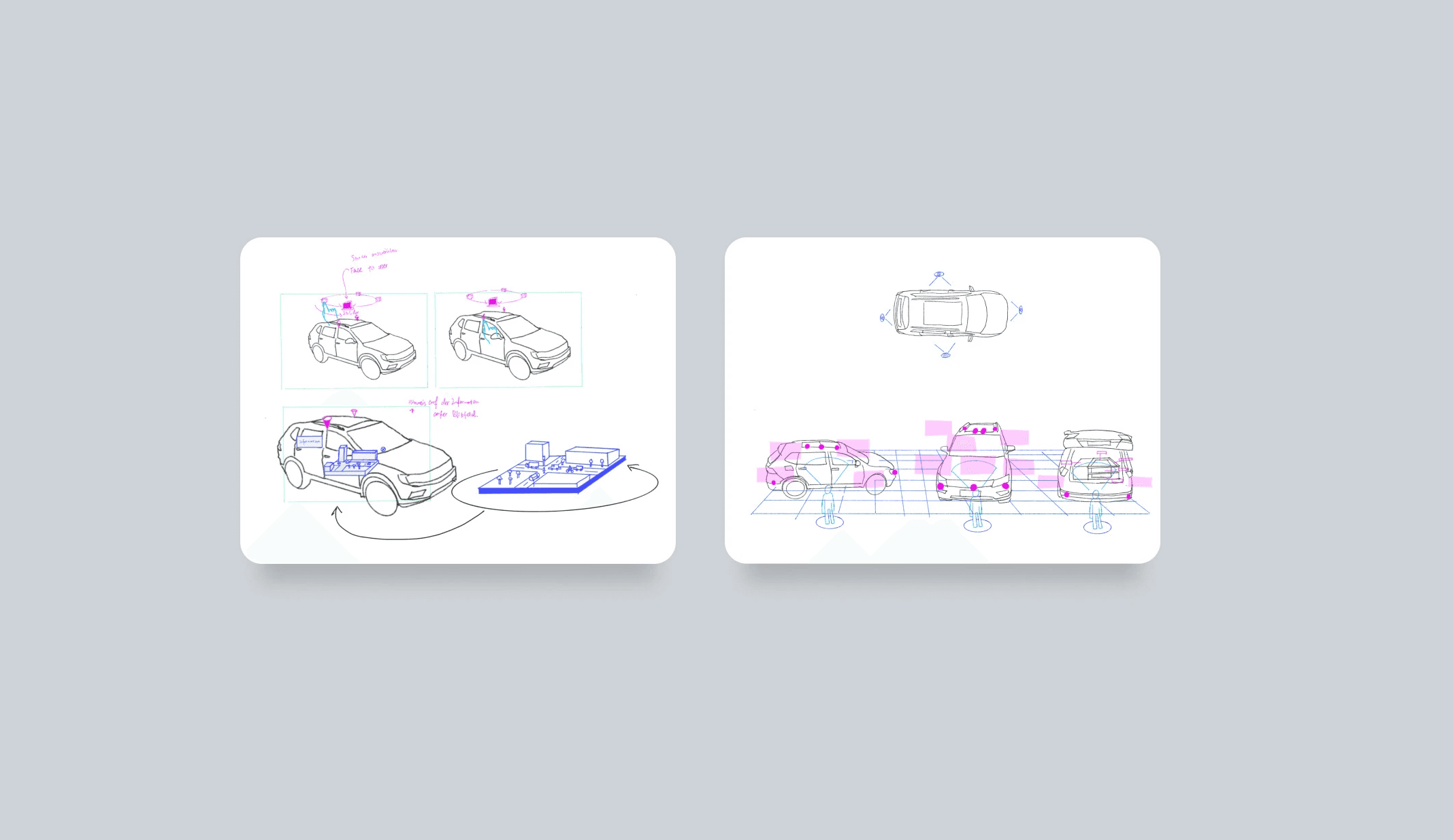
Early in the project, it became clear that the application had to serve two very different demo contexts. In contexts where the physical vehicle could not be brought along (international trade shows, public outreach events), the application works in a fully virtual mode: a 1:1 3D model of the vehicle and the delivery robot, with sensor and point-cloud information rendered on the virtual asset. In contexts where the real vehicle is on site, the application switches to a combined real-and-virtual mode: visitors and presenters can walk around the actual car, while the spatial layer overlays sensor positions, LiDAR point clouds, and live cloud data directly onto the real fleet. Treating these as one product, not two, was a deliberate choice.

The design iterations were validated through internal user testing with approximately ten participants from the broader DAI-Labor and TU Berlin context, focused on first-time mixed-reality users and on how clearly each layer of sensor information could be read in a few seconds.

BeIntelli scene

Understanding autonomous driving technology can be challenging for visitors without seeing the vehicles and robots in action. Additionally, the field is filled with complex technical terms, making traditional explanations feel abstract and difficult to grasp.

BeIntelli AR view

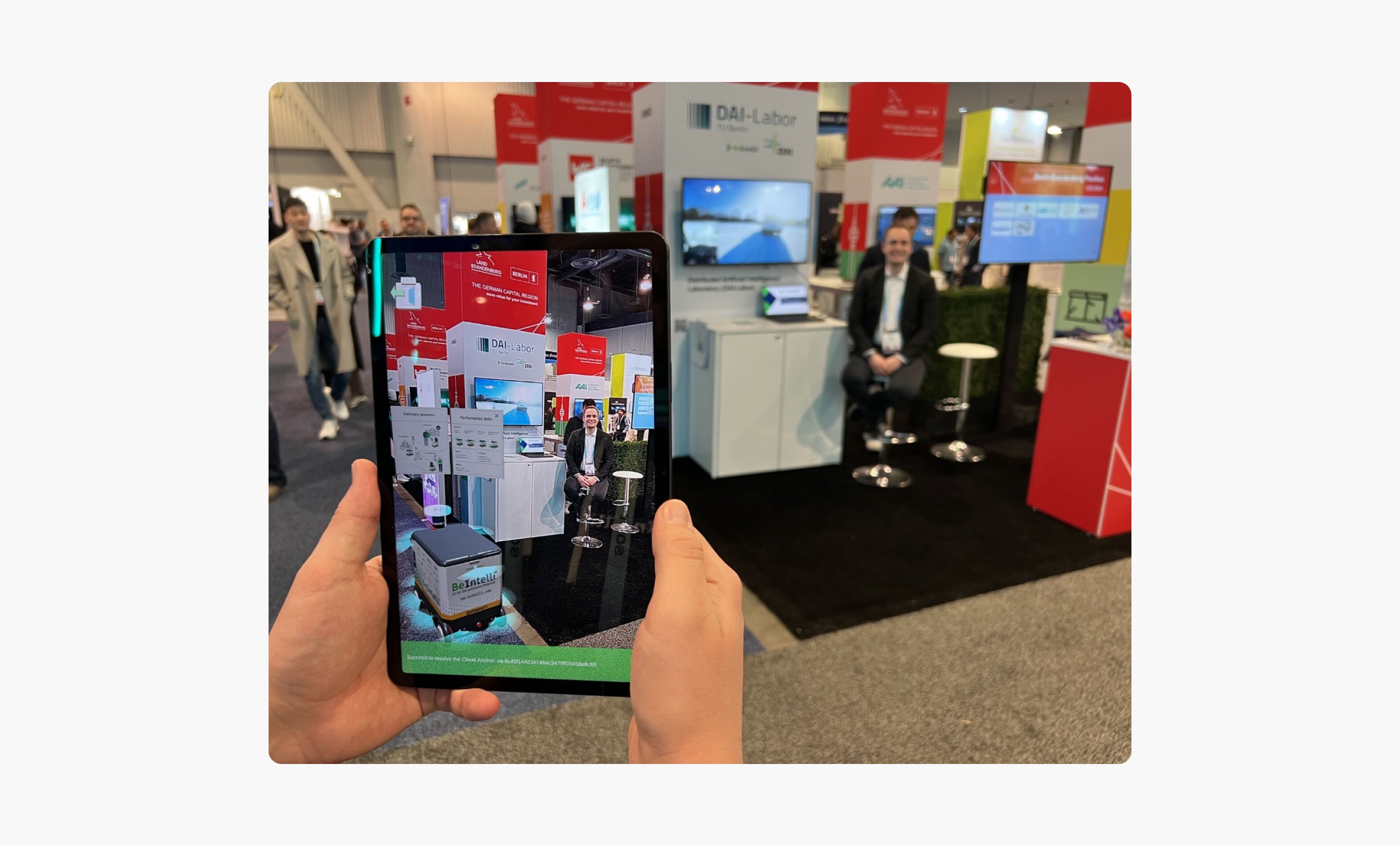
In situations where our autonomous vehicles and robots are not physically present, we developed a 1:1 3D model of the car and delivery robot. This model displays real-time 3D LiDAR point clouds in augmented reality (AR) and provides detailed sensor information, creating an immersive showcase of our technology.

02 · Designing for the AI in Mixed Reality

Visualising what the autonomous fleet perceives

BeIntelli AR turns the autonomous fleet's machine-perception into a spatial visualisation that a non-expert visitor can read in seconds. The design challenge was deciding which signals from a complex perception stack should be made visible at all, and how each should be expressed in a shared mixed-reality vocabulary.

The perception stack as a layered visualisation. The MR scene composes several layers: the real-time LiDAR point cloud emitted by the vehicle, the sensor cones and fields of view for each on-board sensor, the sensor positions on the vehicle itself (so a visitor can connect a point on the car to a specific sensor in the visualisation), and the object recognition layer, which highlights what the vehicle currently identifies as an object of interest. Each layer is independently switchable, so the presenter can guide a visitor from the simplest layer to the most detailed one.

Live data integration with the cloud. When the real vehicle is on site, the MR view is connected to the live data pipeline so that the point clouds, sensor cones, and object detections shown are not pre-recorded but reflect what the vehicle is perceiving at that moment. The supporting telemetry from the sensors is rendered alongside the visualisation as contextual information.

Spatial information density. Mixed reality demands different rules than a 2D screen: the user's gaze is unconstrained, the surrounding environment is part of the canvas, and the visitor is physically moving. The information density was tuned so that the most important signal (a recognised object, the live point cloud) is dominant in any viewing angle, and the secondary signals (sensor positions, telemetry) reveal themselves only when the visitor approaches that part of the vehicle. The same product therefore works equally well in the fully virtual demo mode and in the combined-with-real-vehicle mode: the information hierarchy adapts to context, the underlying design system does not change.

When vehicles and robots are available on-site, we enhance interactive exploration by overlaying 3D virtual information onto the real cars and robots using geolocation, allowing visitors to engage with the technology in a more dynamic way.

03 · Outcomes

From research demonstrator to international stage

BeIntelli AR is in active use as the visual demonstrator for the BeIntelli initiative. The application has been shown at the Consumer Electronics Show (CES) in Las Vegas, and is part of the regular programme of the Lange Nacht der Wissenschaften, the long-running public science outreach event in Berlin.

Beyond these public events, the application is used continuously whenever partners or external visitors come to the lab. The fact that it has remained the standard visualisation tool across these very different audiences, from the international tech-industry context of CES to the academic outreach context of the Lange Nacht and to closed partner demos, is the validation that matters most for a research demonstrator of this kind.

The main challenge of this project was its technical implementation. As the Product Owner, I had to think boldly, explore technical possibilities, and repeatedly test designed interactions across various application scenarios to ensure a seamless and effective experience.

BeIntelli final